
Digital Mediations
Reflections On Virtual Meetings and Digitized Manuscripts

It is cliché to note that our lives as human beings—in every facet now and almost universally across lines of class, ethnicity, gender, geography, and so on—are inexplicably shaped by the digital, that so much of our lives take place in interaction in some way with electronic screens. Even when we are not directly in front of a screen our imaginations, our perceptions of the world, are being shaped by the residual effects of those interactions. The infrastructure of data creation and use surrounds us on-screen and off; the physical footprint necessary for the sustenance of digital networks, from sprawling data centers to the connective tissue of cable and satellite and electrical lines, have spread out along the contours of twentieth century industrial structures and increasingly beyond them.
The question of the digital is quite possibly the question of our time, so bound up with every aspect of life as it has become, from the shape of the global economy at the highest levels to the most ordinary rhythms of daily (and nightly!) life. The dramatic gains of function that generative AI has seen over the past years—months even—are simultaneously in continuum with the larger patterns that have been unfolding in force over the length of my lifetime while also representing a real transformation within those patterns, and moreover forcing us to confront head on that larger technological complex that now enfolds the earth. It is not surprising that Pope Leo’s first encyclical of his pontificate, Magnifica Humanitas, deals so extensively with these very questions and their profound social, political, cultural, and indeed spiritual implications and entanglements.
I do not have the intellectual or spiritual acumen, and certainly none of the authority of office, of His Holiness, but I do take heart from his call to all people of good will to join in this task of making sense of our situation and turning it, as best we can and in solidarity and cooperation with others, towards the good of human flourishing and community. As our regular readers will have noted, a theme that has emerged in our work this year (even before the Papal summons to such work!), particularly as manifest in this newsletter, is a critical evaluation of where we are in terms of the digital humanities and indeed in the digital world in general. We have some additional offerings towards this end that we will publicize here soon, including a critical digital technologies reading group that we will be launching soon (I’ll post further details here soon, in the meantime if you’d like to sign up go to the linked-to form).
For today, what I want to primarily focus on in this essay are some ways specific to my own scholarly work and to our activities with OpenITI within which the digital has made possible some genuinely positive things—and the ways in which those positive things interact with, sometimes to their detriment, with other, arguably more totalizing aspects of the wider digital economy and ecosystem. Digital environments enable forms of mediation of knowledge, relationships, perceptions, and so forth, that build on and out of previously existing forms of mediation but are fundamentally different in how they relate to time, space, distance, speed, and volume. The interaction of all of the forms of the digital, forms which are heterogeneous in origin and composition and ends, can produce incredibly powerful and productive forms of mediation, while also generating some deeply deleterious effects, particularly when the dynamics of ownership and configuring power are heavily weighted to a few controlling actors.
In this essay I’ve picked out two digital technologies that I at least make use of almost every day and which are both incredibly central to OpenITI’s current work: the virtual meeting (in our case, using the proprietary software of Zoom) and the digitized manuscript. Both are such regular features of my life that for the most part I do not think about them qua technologies, but both provide good entry points into the positive affordances of the digital as well as its limitations and compounding factors from other digital directions.
I do not remember the first virtual meeting I attended, not even the general time frame in which it might have happened. I do remember, more or less, starting to host online reading groups in the late 2010s, a few years in fact before so much of the wider world discovered the frustrations and joys of virtual meeting during the annus horribilis of 2020. Over the last five years I have hosted what feels like countless online meetings, trying to figure out the best ways to maintain what have become over time virtual scholarly communities dispersed in space and time (in the sense that virtual meetings held on a global scale must negotiate time zone differences). I am not alone in this of course; the virtual video-based meeting is a global commonplace today (to the point of being the central motif of a truly awful but hilarious War of the Worlds “remake” staring American musician Ice Cube).
As such the virtual meeting is a digital technology that we tend to take very much for granted, or actively dislike because of the often negative connotations such meetings have often taken on (“could have been an email”). Yet we have found over the past several years with our virtual reading groups that such meetings, if given clear direction, a sustained focus, and maintained over time, can be truly positive, and mitigate against some of the deleterious effects of electronic communication in other modalities. In the case of our meetings at least there is no anonymity, no digitally specific invented personas or avatars; most participants at some point interact face-to-face. We hear one another’s voices across thousands of miles of space and fraught geopolitical space. Interactions are not identical to those that would take place in an actual physical shared space, to be sure, but they are also quite different from the “classic” mode of internet interaction, that of the anonymous poster arguing with or riffing of or merely passively engaging with other anonymous posters (no few of which today might be bots or AI agents).
It is the face-to-face nature of video communication that makes it so powerful, and also challenging—it is easier to participate anonymously, to turn off the camera and to zone out. And to be sure even with the proverbial camera on it is easy to get distracted, to turn one’s attention to other things flashing on the screen. That said there is no bright line between the digital distraction we encounter during virtual meetings and that which afflict any gathering of more than a couple people—screens in pockets have a habit of intervening, of foreclosing on the act of mediation among people and other media.
The virtual meeting has its limitations, obviously. The kind of person-to-person interactions that are possible before, during, and after an in-person discussion group or meeting are hard to maintain above a certain number of participants. The full range of cues and modes of interaction that we as embodied creatures inhabiting physical space incorporate into communication are absent, though there is a stronger sense of the body than in, say, telephone conversations. I suspect that these limitations also explain the tendency of online discussion groups to fluctuate in number of participants over time; though we have found that as long as there is a small core of regular discussants a reading group can be maintained for a long time indeed. We are further fortunate to have, on our end at least, some degree of institutional backing, or, at least, tolerance; that said few universities are set up to formalize these kinds of virtual interactions and communities, which is both an advantage and a limitation I suppose.
Speaking of universities: institutional support for language study and for broader philological pursuits has been in long decline in this country at least, and is now pretty much in free-fall. As many history and other departments reduce the number of PhD students they admit—due, primarily, to the bleak job prospects in the humanities—it is growing harder and harder for what graduate students remain to find colleagues with whom to read texts in their research languages. Speaking for myself, the number of other students in Islamicate studies disciplines at my institution had dwindled to almost nothing by the end of my graduate work. In my current place of residence I do not think I could find anyone else to read Ottoman Turkish texts with me, and putting together a Persian reading group with the relatively small number of interested people in my area would be challenging though perhaps not entirely impossible. But thanks to the digital infrastructure spanning the globe I can sit down at my desk once a week and work line by line through an Ottoman manuscript with like-minded people around the world, and that is really quite incredible when you stop to think about it.
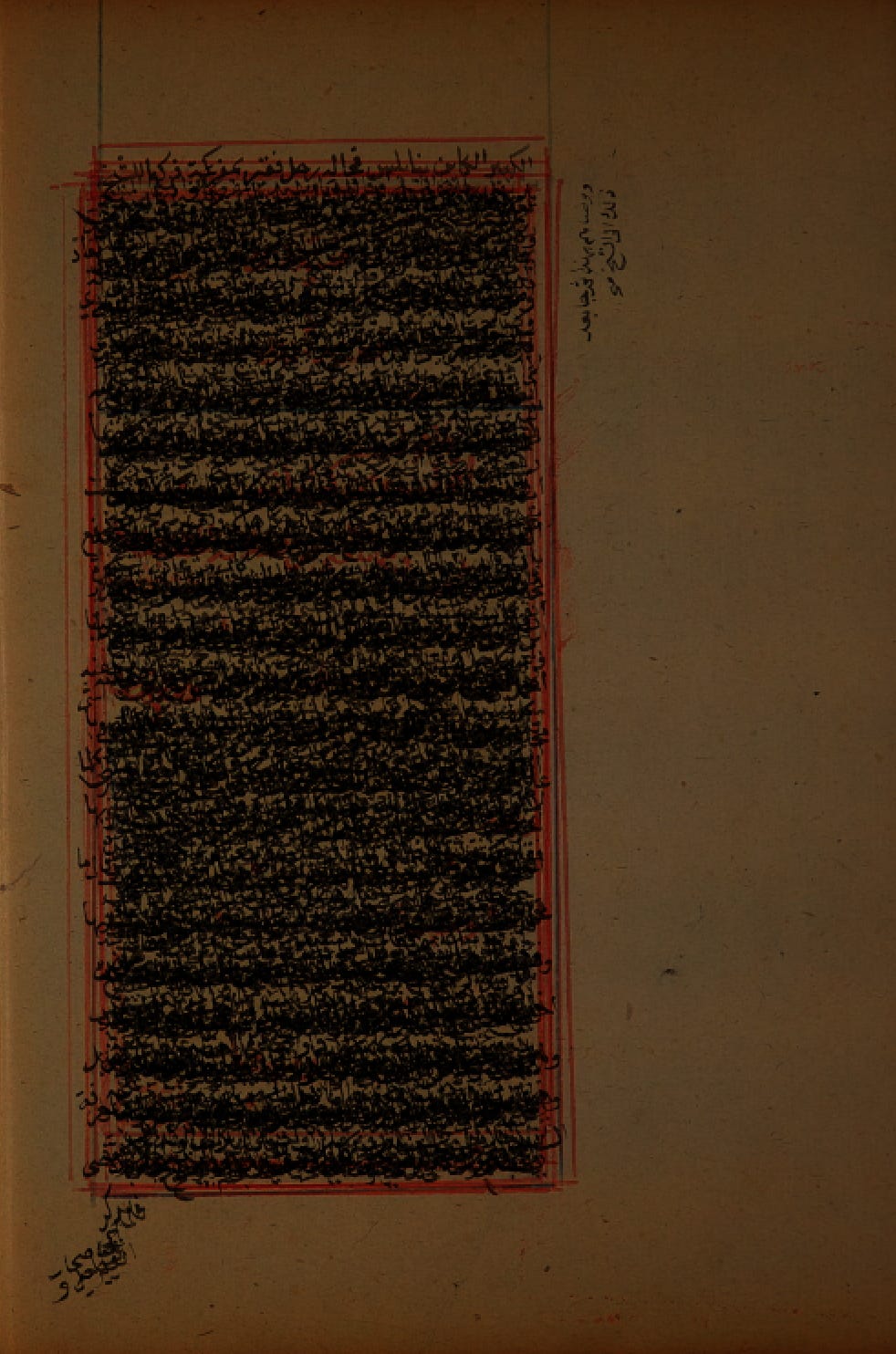
Even more than the virtual meeting, the digitized text—in our case as scholars of pre-modern Islamicate societies, the digitized manuscript in particular—has truly transformed scholarly life in ways that I do not think we risk over-stressing. Simply accessing academic monographs has become inestimably easier in terms of getting a hold of a book upon publication (though discoverability in the case of digital texts often leaves something to be desired compared to the library or bookstore experience, but that is another conversation). The situation for reading pre-modern manuscripts is even more dramatically different: when I started graduate school I was in the same situation as graduate students had been for centuries in that if I wanted to read manuscript exemplars of the texts in which I was interested or that I thought would be useful, I had to go to the physical repository. Digitized manuscripts were few and in-between, and while some libraries would digitize them for you they required payment, usually more than I was eager to fork over. I made many trips up to Princeton for the sole purpose of manuscript reading, and while it was an enjoyable experience (fortunately I have family in northern New Jersey with whom I was able to stay on my research trips) it limited my engagement with manuscript texts, and I was not able to include as many manuscript texts in my dissertation, nor was I able to engage in the kind of critical multi-witness based approaches that would have strengthened and deepened my findings.
Fast forward a few short years and we find ourselves awash in digitized Islamicate manuscripts. No one seems to know how many digitized manuscripts are available at the moment as there is no union catalog that brings them all together (and I rather doubt there ever will be), but I would not be surprised if the number is approaching a million if we include digitized manuscripts that are not fully freely accessible (Turkey’s vast digitized collections, for instance). Whatever the number we can expect it to continue to rise. Contemplating this absolute glut of digitized texts is exciting, but it is also rather anxiety-inducing: what can, if anything, one do with such a vast number? Where to start?
Anxiety over increasing information is nothing new, but that is not because the anxiety is misplaced. Late medieval thinkers across Afro-Eurasia struggled with the implications of expanding textuality, driven by technical and economic transformations that put more and more information in circulation by means, primarily, of codices with paper pages. Knowing how to manage all that information, particularly within communities of scholarship for whom mastery of textuality was central to self-identity and professional practice, assumed greater and greater importance, and remains one of the most vital if difficult to master skills in our own world. The expansion of information, of available texts, is both a good and a limitation of a sort. In the case of digitized manuscripts in particular I think, we find the sheer abundance to be something of a double-edged sword. It is easy—and I imagine if we could do anonymous polling of academics, pretty pervasive—to confront the sheer abundance now on tap and end up doing nothing with the riches now available. It is also incredibly easy to lose focus, to not only want to read everything but to be able to download and at least imagine reading everything, but ending up reading very little. I know this from personal experience, and I suspect you do, too.
The explosion in digitized manuscripts has happened alongside other digital transformations that have changed our scholarly lives in many ways, not all of them beneficial. The ready glut of texts extends to academic monographs, too, of course—I will not tell you how many I have opened on my desktop and laptop right now or how long some of them have been opened, but I am sure you can guess, dear reader. Part of our problem is that the reading environment for the digitized text is just not a great one, or at least it requires a lot of effort and intention to craft a good reading environment on a screen. Distraction—in the form of wanting to see what new horror has transpired nationally or globally since your last check-in, or through looking up some obscure place name or term and getting lost down a rabbit trail, or in taking a “break” to scroll Twitter—is pervasive, indeed it essentially is how the internet is now structured in our era of capitalist digital enclosure. When, as is often the case, a manuscript poses a real challenge in terms of paleography it is easy to lapse into distraction or simply to shift to another, easier task. The kind of deep, close reading that many of us probably once practiced regularly is not encouraged by most digital formats.
Herein lies one of the crueler ironies of our age: many of the truly incredible technical achievements, digital tools, and electronic databases and repositories that have become available are being progressively rendered less and less useful by the reshaping of our habits and capacities through interactions with other digital technologies. It is now technically (in the full meaning of the term!) possible for me as a scholar of decidedly modest means to do research and deep readings of manuscript texts in ways that would have been absolutely prohibitive a few years ago. I cannot afford to travel to Istanbul or Vienna at present, and while I could perhaps just afford to make a trip or two a year to Princeton or Yale my time would be very limited in those libraries. Being able to summon their digitized holdings is incredible—but if I am to read and make use of these texts in the same way I once did while reading them in situ I must be very deliberate about it. Reading groups help, if I may plug them again, precisely because they replicate, if in a somewhat less intense manner, real-world reading dynamics and practices.
Let me conclude with a bit more abstract of a suggestion about the digitized manuscript and what I think is its importance in our world of ever increasing irreality, a world in which the correspondence between the real and the digitally generated blurs more every day and in which the digital (with all of its political, cultural, spiritual, and other implications) becomes more and more hegemonic. It is true that like other digital “objects,” a digitized manuscript exists in a near-infinitely reproducible form, very different indeed from the “real” manuscript, the laborious work of a scribe copying letter by letter by hand. However, the digitized manuscript is crucially always anchored in the “real world,” it refers back very concretely and irreducibly to something real, something with an actual history and genealogy of production and use and circulation. These histories might not always be easily recoverable, or recoverable at all, but they exist nonetheless. Travel to whatever library or archive your text sits within and you can, in theory at least, feel the paper, hold the book, smell its scent, lean in close and read the words directly. Your fingers align with the fingers of previous generations that once did the same, and there is something powerful and beautiful about that. You might not be able to have the same tactile experience with a digitized text, but you can still see the haptic traces of past hands, past lives, in the words, ink spills, doodles, careful calligraphy, and so on. There is a strong sense of “thisness” with the manuscript, even as a digitized exemplar.
The “artefact” of generative AI does not have this. The anonymous avatar but who becomes a presence, an “internet friend,” is real—the AI chat bot is not, it is utterly ephemeral, unrooted in any concrete historical existent, but is rather an artificial generalization, a product of training data lumped into one big pot. It doesn’t really mediate anything to you in the way that our digitized manuscript does, because there is not real “there” there. If—and as far as I can tell this is not yet possible, though perhaps it will be eventually—you could ask Claude or Grok to generate “a manuscript” it would not have those histories embedded in its pages, it would not hail from an actual place and time. Interacting with manuscripts, including digitized ones, can help to ground us in the world and in the particularities and imperfections of human (and other-than-human) history, and, in combination with other practices and with much care and discipline, mitigate against the effects that our technologies and technological world have upon us. And that is, I think, a hopeful thought upon which to end today.